Best Bedside Step Stool with Safety Handle for Bed Access
We tested the Step to Bed adjustable bedside step stool — rubber grips, dual handles, and a built-in motion sensor light. Here's what actually held up.

Reviewed by
Seb and Michelle
We've tested over 6,500 products in the last 5 years – collaborating with over 4,000 brands and bringing our style of reviews to multiple platforms. More about me →
This post contains affiliate links. I may earn a commission at no extra cost to you.
Quick Verdict
I didn’t know a bedside step stool with safety handle like the Step to Bed existed until I had it in my hands, and now I kind of can’t believe people with high beds are getting by without it. The thick rubber grips on the bottom mean it doesn’t slip or slide at all, and the adjustable handles give you real support whether you’re getting in or out. I tried pushing it sideways and it didn’t budge. That’s the kind of stability that actually matters when you’re half asleep at 2am.
Buy if you:
- Have a high bed and struggle to get in or out safely
- Want a built-in motion sensor nightlight for dark rooms
- Need adjustable handle heights to match your specific mattress setup
- Care for an older or mobility-limited family member at home
Skip if you:
- Have a low platform bed that doesn’t need a step-up
- Don’t plan to attach the Velcro anchor to the bed frame
- Need something rated for heavier weight loads (no capacity listed)
Clicking takes you to the seller's website. We may earn a small commission if you purchase, at no extra cost to you.
Choosing a Bedside Step Stool With Safety Handle
Okay, so I literally almost fumbled my opening on this one. I kept starting and stopping because I wasn’t sure how to explain what this thing even is. But here’s the simple version: if you or someone you know has trouble getting in or out of bed — whether it’s pain, age, or just a ridiculously high mattress — the Step to Bed is worth a real look. I had it sent for my review and I think this is really awesome. It’s a bedside step stool but with two adjustable safety handles and a built-in motion sensor light. And that combination, I’ve never seen one like this.
Our bed is pretty high, mainly because of the mattress. So when I set this up next to it, I got the full experience — and I pulled Walter in as my co-star for the demo, obviously. That French bulldog earns his keep.
Let me walk you through everything I noticed, because there are a few details that most people gloss over and they’re kind of the whole point.
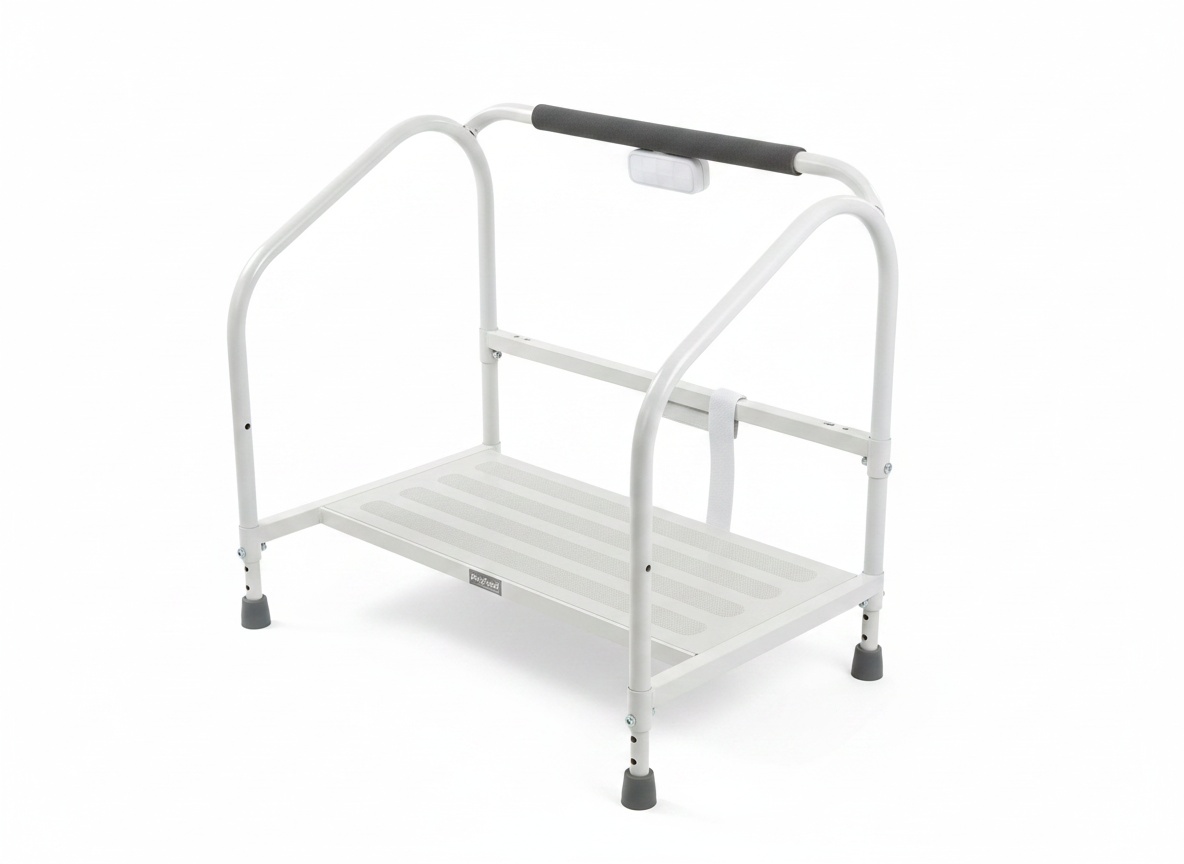
What the Step to Bed Is Actually Built With
The first thing I noticed before even using it was the base. There are really thick rubber grips on the bottom — not thin little stick-on pads, proper grippy rubber. I tried pushing the stool sideways with some force and it’s not going to go anywhere. It’s not slipping and sliding. That’s not a minor detail when you’re stepping down at night.
Then there are two handle bars. You’ve got one you can use to pull yourself up while you’re still in bed, and a second one positioned for when you’re stepping down. Both give you real support. I do like that you have the little handles there — they’re not decorative. You can grip them and feel the difference.
The bar height is adjustable. This matters because beds are not all the same height. Ours is pretty high mainly because of how thick the mattress is, so I noted during my demo that one of the bars probably needed to come down a little to match. You adjust it at the legs, which is pretty straightforward.
There’s also a Velcro attachment system included. You get two Velcro pieces that let you anchor the bar directly to your bed frame for extra security. I hadn’t attached them yet when I was demoing it, and even without them, it held firm. The rubber grip base does most of the work. But if you want that added peace of mind — especially for someone who uses this every single day — the Velcro is a nice bonus to have.
And then there’s the motion sensor light. It sits right on the stool frame. When I was showing it, it wasn’t turning on because there was too much ambient light in the room — which is exactly how a motion sensor light should work. At night, though, any movement near the stool will trigger it. So when you swing your legs over and go to step down at 2am, it automatically lights up. It kind of serves as a nightlight. I think this is really cool.
Getting In and Out of Bed — The Actual Demo
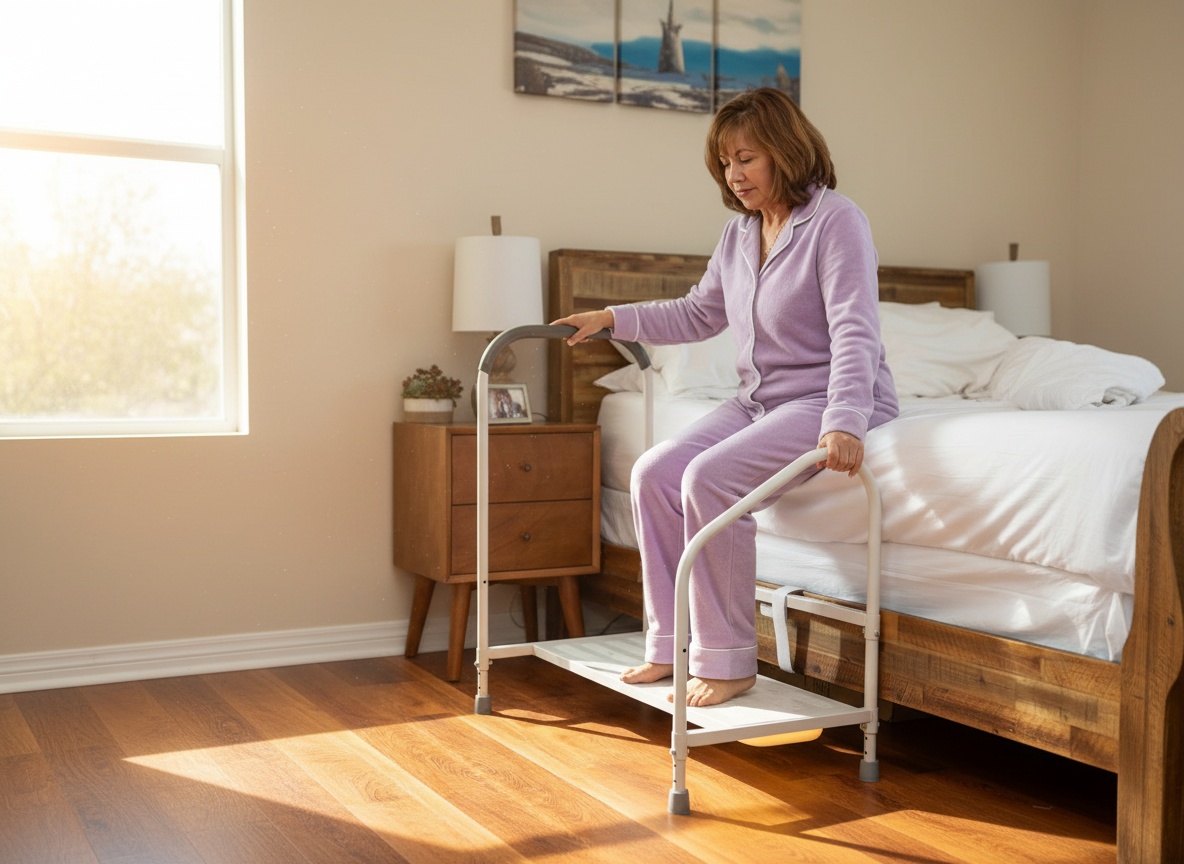
So I got Walter onto the bed with me and ran through the full routine. You’re lying down, normal sleeping position. You want to get up. You use the first handle to pull yourself into a sitting position. Then you swing your legs over. The second handle is right there to grip as you step down onto the stool platform. That way you’re not jumping or lowering yourself awkwardly from a high mattress. You step down in control.
Getting back in works the same way in reverse. You step up onto the platform, use the handle for support, turn yourself around, and sit down onto the bed. Then swing yourself in. I do like that you have the little handles there. You’ve got that support the whole time.
The bed I was on is pretty high, mainly because of the mattress, and the Step to Bed handled it cleanly. No wobble. No flex. It sat there solid while I stepped on and off. That’s the thing most people wonder about with a stool — will it shift when I put my weight on it? This one didn’t.
The one adjustment I flagged during my demo was the handle height. Because my mattress stacks so thick, the upper bar was a touch high for ideal grip comfort while sitting on the edge. The fix is simple — adjust the legs to lower the whole unit slightly. But it’s worth doing before you hand this off to someone who’s going to use it daily.
The Motion Sensor Light Changes Everything at Night
Here’s the detail that most step stool reviews don’t even mention: the light.
Getting out of bed in the dark is genuinely one of the riskier things people do every night without thinking about it. You’re disoriented, groggy, and you can’t always see where your feet are landing. The Step to Bed has a motion sensor light built right into the frame. It doesn’t need you to tap a button or fumble for a switch. Any movement near the stool — like swinging your legs over — triggers it automatically.
When I tested it during the day, it didn’t turn on. That’s correct. There was too much light in the room. But at nighttime, that same motion would have lit the area up. It serves as a nightlight. That’s a function I wasn’t expecting and it genuinely made me like this product more.
For someone who’s older or who has balance concerns at night, that light isn’t a gimmick. It’s a real safety feature. The stool is already handling the height problem. The light is handling the visibility problem. Both things working together is kind of the whole point of this product.
Learn more
Step to Bed Safety Step Stool
Get the best price today →This post contains affiliate links. I may earn a commission at no extra cost to you.

Who This Stool Is Really For
The obvious answer is seniors and people with limited mobility. And yes, this was clearly designed with that in mind. If someone in your home is older, recovering from surgery, dealing with hip or knee pain, or just struggling with the daily mechanics of getting in and out of bed — this is a direct solution. The handles give them something to grip. The step reduces the height gap. The light means they’re not doing it blind.
But, it’s not just for seniors. If you’ve ever stacked your mattress and added a thick topper and suddenly your bed feels like a climbing event every morning — the Step to Bed makes sense for you too. It’s not a medical device. It’s a practical tool for a really specific problem that a lot of people have.
I think this is really unique. I’ve seen step stools. I’ve seen bed rails. But I’ve never seen one like this — where the stool and the handle system and the light are all combined into one thing that sits right next to the bed. That combination is what makes it different.
Caregivers managing a parent or family member who lives with them — this one’s worth bookmarking. It’s low-profile, it stays put, and it gives the person using it more independence without needing someone else in the room to help them up.
How It Stacks Up Against a Basic Bed Rail or Regular Step Stool
A standalone step stool — the kind you’d use in a kitchen to reach a high shelf — is not this. Those usually have no handle, no stability mechanism, and nothing to grip. They’re fine for reaching things but they’re not designed for someone who needs support getting onto a bed.
A standard bed rail, on the other hand, gives you the handle but not the step. So if your mattress is high and you’re still dropping a long way to the floor, the rail doesn’t solve that part of the problem. You’re still landing hard.
The Step to Bed handles both. The step brings the floor closer. The handles give you something to push and pull against. And the combination means you’re not relying on your core strength or knee stability to do the heavy lifting. For someone with morning stiffness or limited lower body strength, that matters a lot.
The one thing a dedicated bed rail has going for it is that it bolts directly to the bed frame and goes nowhere no matter what. The Step to Bed uses thick rubber grips and the optional Velcro system, which was solid in my testing — it didn’t budge when I tried to push it sideways. But if someone is very unsteady and applying significant lateral force on a bad day, taking a few minutes to properly secure the Velcro anchor is the move. Don’t skip that step.
Set It Up Right the First Time
The setup is simple but there’s one thing I’d flag: adjust the bar height before you hand this off to someone. I noted during my demo that one of the bars was a little high for my bed setup and needed to come down depending on mattress height. Take two minutes to sit on the edge of the bed, reach for the handle naturally, and see if the height feels right. Adjust at the legs if it doesn’t. It’s not complicated, but it does affect how comfortable and useful the handles are during real use.
Also don’t skip the Velcro anchor. The rubber grips do their job on flat flooring — I tried pushing the stool sideways and it held firm. But if the stool is going to be used multiple times a day by someone who might grab the handle with some urgency, attaching it to the bed frame removes any remaining doubt. It’s included in the box. Use it.
Place it on the side of the bed the person actually uses to get up. Sounds obvious, but it’s worth thinking about before you commit to a spot. And if the floor surface is anything other than solid hardwood or tile — carpet, for example — check that the rubber grips are making full contact. A thick rug underneath could reduce the grip effectiveness.
Check the current price and availability for the Step to Bed on Amazon here — pricing does fluctuate so always worth checking what it’s sitting at before you buy.
Frequently Asked Questions
Does the Step to Bed actually stay in place, or does it slide around?
It stays put. The thick rubber grips on the bottom hold it firmly on hard flooring — I pushed it sideways during my demo and it didn’t move. For extra security, the included Velcro pieces let you anchor the handle bar directly to your bed frame, which removes any remaining concern about it shifting.
How does the motion sensor light work?
It’s a motion-activated light built into the stool frame. It doesn’t turn on during the day when there’s ambient light in the room — that’s by design. At night, any movement near the stool triggers it automatically, so it lights up the area when you swing your legs over to step down. It serves as a nightlight without requiring you to do anything.
Can you adjust the handle height to match different bed heights?
Yes, the handle bars are adjustable. You make the adjustment at the legs of the stool depending on how high your bed sits. If your mattress is thick — like mine — you may want to lower the bar slightly so the grip height feels natural when you’re sitting on the edge of the bed.
Is this only useful for elderly users, or is it practical for anyone with a high bed?
It’s useful for anyone dealing with a high bed, regardless of age. Seniors and people with mobility limitations are the primary use case, but if your mattress setup is just tall and getting in and out is awkward, this solves that problem cleanly. The handles and step work the same way for anyone who needs them.
Do you need tools to set it up?
No tools needed. The setup is straightforward — the main thing to do is adjust the bar to the right height for your bed and attach the optional Velcro anchor to your bed frame. Both are quick and don’t require anything beyond what’s in the box.
Related reviews
- Numanu Telescopic Camping Stool: Portable Seat
- SV3C Solar Security Camera Review: 4-Camera Kit
- Allulose Zero Calorie Sweetener Syrup Review
Can you use the handles to pull yourself up from lying flat?
Yes, that’s part of how it works. You can grip the handle to pull yourself into a sitting position while still in bed, then use the second handle as you swing your legs over and step down. The dual-bar setup supports the whole sequence of movement, not just the final step down.
Learn more
Step to Bed Safety Step Stool
Get the best price today →This post contains affiliate links. I may earn a commission at no extra cost to you.
About the reviewer
Seb and Michelle
We've tested over 6,500 products in the last 5 years - collaborating with over 4,000 brands and bringing our style of reviews to multiple platforms.