FitBeast Adjustable Hand Grip Strengthener Review
I tested the FitBeast adjustable hand grip strengthener from 10 lbs all the way up. Here's what the dial actually feels like at the top end.

Reviewed by
Seb and Michelle
We've tested over 6,500 products in the last 5 years – collaborating with over 4,000 brands and bringing our style of reviews to multiple platforms. More about me →
This post contains affiliate links. I may earn a commission at no extra cost to you.
I wound the knob to maximum, said on camera I couldn’t close it, then did, and that settled the only question that mattered: does a plastic device with a single knob actually deliver 132 lbs of resistance, or is that number just marketing? It’s real. That range, on one dial, no spring swaps, is the whole pitch for this adjustable hand grip strengthener, and it’s the thing I doubted most going in.
Quick Verdict
I said out loud that I’d never close this thing at the top of the dial. Then I closed it, and I felt very proud of myself. One knob takes it from 10 lbs to 132 lbs, and the rubberized grip is comfortable at every setting in between.
Buy if you:
- climb, lift, or play a sport where your grip gives out before your muscles do
- are rehabbing a hand or forearm and need to start at 10 lbs, not 60
- sit at a desk all day and want something you can squeeze between emails
- don’t want to buy five fixed-resistance grippers as you get stronger
Skip if you:
- expect the dial numbers to be exact. Turning it is easy, but you’re eyeballing the gauge and adjusting by feel, not setting a precise weight
- want a solid steel gripper. The body of this one is plastic
- only ever train one hand at a time and don’t care about the range
| Resistance range | 10 to 132 lbs |
|---|---|
| Adjustment | Turn knob, numbered gauge |
| Handles | Textured non-slip rubberized, both sides |
| Body / spring | Plastic housing, steel spring |
| Exercises | 6 (hand, fingers, forearm) |
| Handedness | Ambidextrous |
Adjustable Hand Grip Strengthener Proved Me Wrong
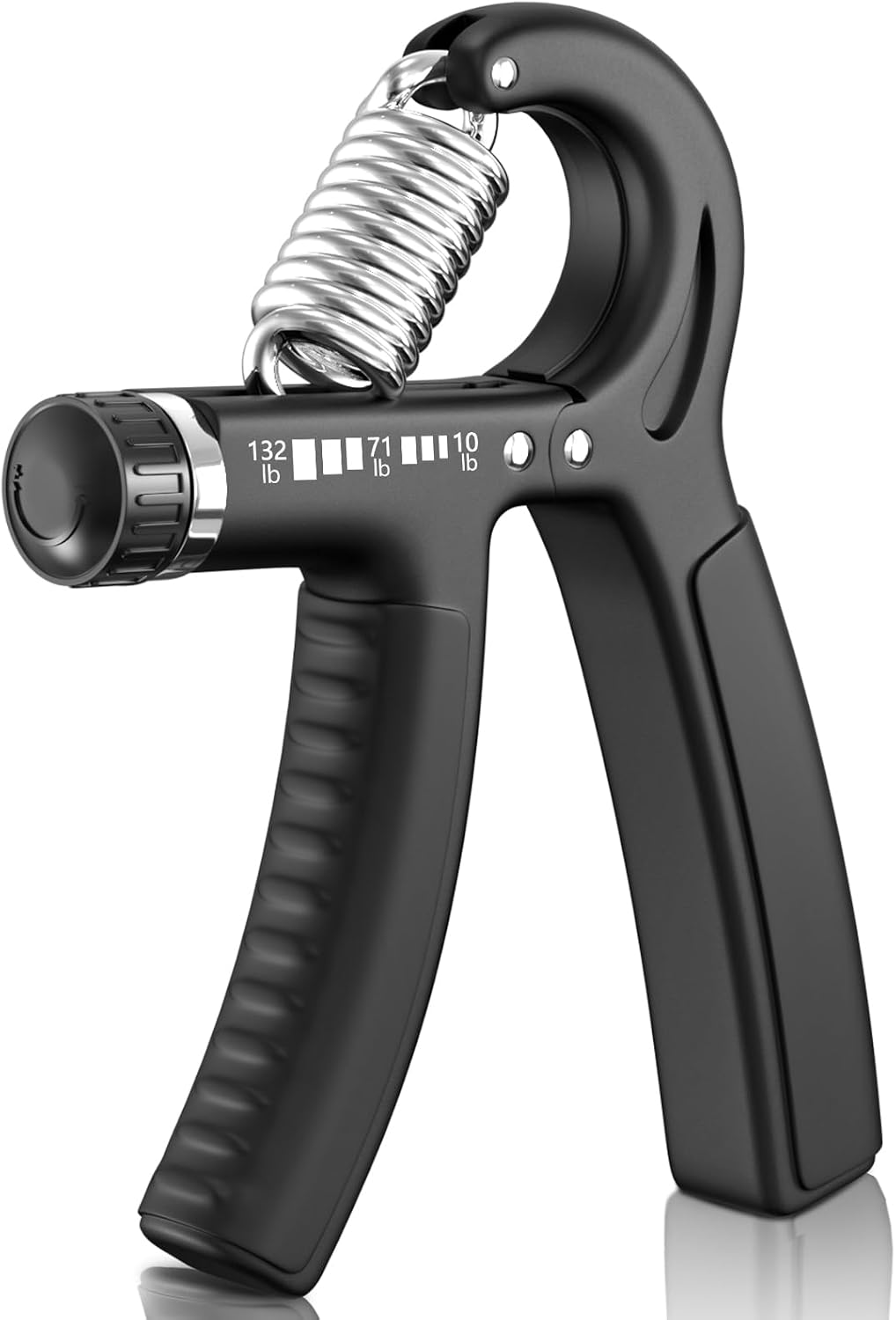
I started at 10 lbs, which is the easiest setting on it. Squeezing that is nothing. Then I wound the knob all the way to the top end and said, on camera, that I can guarantee you I will not be able to do 132 lbs because that is absolutely wild.
I closed it. My forearm was lit up past the wrist, my bicep was bracing, and I was genuinely surprised, not just that I’d done it, but that 132 lbs stops being a grip exercise and becomes a full-arm event.
The Knob Does One Job and Does It Fast
Adjusting resistance takes a couple of turns, no tools, no swapping springs. You hold the gripper and rotate, and you can watch the mechanism physically travel toward the knob. I went super slow on camera so you could see it move, because it’s the kind of thing that looks like nothing in a product photo.
The rubberized handles on both sides matter most at the heavy end, and here’s why: cheap grippers dig a bare metal bar into the base of your fingers at high tension, so you quit the set because your skin gives out before your forearm does. At 100-plus pounds on this one, I never thought about my hands, only about closing the thing.
It’s ambidextrous, so left or right, same tool, no reversing anything.
At the Top End It Stops Being a Hand Exercise
At maximum resistance this becomes a full arm workout, not a grip workout. That surprised me. At 10 lbs you’re moving fingers. Dial it up near 132 lbs and I’m bracing, my wrist is loading, my forearm is lit up, and my bicep is getting involved just trying to get this thing working. It’s not just your grip right here. I’m working my entire arm.
Which changes how you should use it. The heavy end isn’t where you live. It’s where you test yourself once, grin, and then back off. Because a one-rep grind at max isn’t training grip endurance, it’s an ego rep. The useful zone is a setting where you can get real reps with clean form and feel the forearm burn build across a set.
That’s exactly what I did on camera. Too hard for me at that point, so a couple of turns like this, and now I feel good and I can do a few more reps. That whole adjustment took maybe three seconds mid-set. No rack of five fixed grippers, no getting up, no hunting for the next weight. That’s the actual argument for an adjustable one, and it held up in real use better than I assumed it would.
The other thing that came out of the test, and I didn’t plan this one: my left arm is noticeably weaker than my right. Same setting, same tool, completely different experience. Clearly, I need to work on my left arm. That is so hard. If you’ve never trained grip bilaterally you probably have the same gap and don’t know it yet, because every two-handed lift in the gym lets your strong side quietly cover for the weak one. A single ambidextrous gripper exposes that in about four reps.
You’re Adjusting by Feel, Not by Number
The friction: I never once set this to a precise number. There’s a gauge on it, and turning the knob is super simple, but in practice what I did was turn, squeeze, turn again, squeeze again, until it felt right. That’s how I found my working weight and that’s how I dropped it back down mid-set.
If you’re the type who logs every session and wants to know you trained at exactly 68 lbs last Tuesday, you’re going to be estimating. It works fine as a progressive overload tool because you can just count turns from a known starting point, but it isn’t a measuring instrument. Worth knowing before you buy it expecting lab numbers.
The other thing I’ll flag: it is a plastic device. The spring is steel and the housing feels solid in hand, but if your mental picture is a machined steel captain-of-crush style gripper, this isn’t that. It’s a plastic body doing a clever mechanical job.
Learn more
FitBeast Adjustable Hand Grip Strengthener
Get the best price today →This post contains affiliate links. I may earn a commission at no extra cost to you.

Three Very Different People Are Buying This
The 10 lb floor is the underrated feature here, and it’s who this is really for. Someone coming back from a wrist or hand injury needs to start light and creep up in small increments. Most grippers on the shelf start way above where a rehab hand should begin.
Then there’s the athlete end. Climbers, lifters whose deadlift fails at the hands rather than the back, anyone in a sport where holding on is the limiting factor. The top of the range gives you somewhere to grow into instead of maxing out the tool in a month.
And the desk crowd. It’s small, it lives in a bag or a drawer, and you can knock out a set while a page loads. FitBeast markets six exercises with it covering hand, fingers and forearm, so it’s not purely a squeeze-and-release device if you want to work different angles.
One Adjustable Gripper vs a Set of Fixed Ones
The fixed-resistance grippers win on feel, the adjustable one wins on everything else. A solid fixed gripper at a set poundage has a cleaner, more predictable spring curve and nothing to loosen over time. That’s a real advantage if you’re a serious grip-sport person chasing a specific number.
But you need a whole set of them to progress, and you need another one for your weak hand, and another when you outgrow the last. The pitch for this adjustable hand grip strengthener is that one knob covers all of it from 10 to 132 lbs. After using it, the part that sold me wasn’t the range on paper, it was dropping the resistance mid-set in a couple of turns without hunting for the next weight, which a drawer of fixed grippers can’t do.
How I’d Set It Up Day One
Don’t start at the top. I did it for the video and it was fun, but it taught me nothing about training. Wind it to 10 lbs first, squeeze a few, then turn up in small increments until you find the point where rep eight or ten is hard. That’s your working setting.
Train both hands every session, even though your weak side will embarrass you. Mine did.
And count your turns from the bottom rather than trusting your memory of where the gauge sat. That gives you a repeatable starting point week to week, which is the only way progressive overload works on a dial-based tool like this.
Pros
- Rubberized grip on both sides stays comfortable at any resistance, no metal bar digging into your palm
- Resistance changes in a couple of turns with no tools, fast enough to do mid-set
- Genuine 10 to 132 lb span, so rehab-light and athlete-heavy both work on one unit
- Ambidextrous, which immediately exposes a left-right strength gap
- At high resistance it trains the whole forearm and arm, not just finger flexors
Cons
- You end up setting resistance by feel rather than by the gauge number
- Plastic body, not a machined steel gripper
- The maximum setting is more of a one-rep party trick than a training zone for most people
What we’d improve
Two changes that wouldn’t be hard for the next version:
- The resistance gauge is hard to trust mid-set, clear detents or numbered click stops on the knob would let you return to an exact setting instead of eyeballing it.
- The plastic housing undersells the mechanism, a metal sleeve over the adjustment barrel would make a well-engineered tool feel as serious as it performs.
Frequently Asked Questions
Can this replace a dedicated forearm roller or wrist curls?
Partly. At high resistance it loads the whole forearm, not just the fingers, so it overlaps with wrist work.
Does it need batteries or an app?
No. It’s fully mechanical: a steel spring, a plastic housing, and a knob. Nothing to charge, nothing to pair, nothing to update.
Is a hand grip strengthener good for arthritis or carpal tunnel?
Ask your physio or doctor before you start, because both conditions can get worse with the wrong loading. What I can say is that the 10 lb floor makes it far more usable for gentle rehab than most fixed grippers, which typically start much heavier.
How do I clean it after sweaty sessions?
Wipe the rubberized handles down with a damp cloth and let it dry. Keep water away from the spring and adjustment mechanism so nothing corrodes or gums up.
Will the spring lose tension over time?
Springs are the wear item on any gripper, so that’s the part to watch long term. Storing it at a low resistance setting rather than cranked to max is the sensible habit. FitBeast lists 24/7 after-sales support, so that’s who to contact if the tension goes soft.
Can two people at very different strength levels share one?
Yes, and that’s one of its best uses. My partner and I train at completely different settings and switching between them takes a couple of turns. A 10 to 132 lb range covers almost any two adults in the same household.
How does it compare to cheap fixed-resistance grippers from a sporting goods aisle?
The cheap ones are typically a single fixed tension with a thin handle that hurts under load. This trades a bit of spring purity for a huge adjustable range and a grip you can hold comfortably at high resistance. If you plan to get stronger, the adjustable route saves you buying three more.
Is it small enough to travel with?
Yes. It’s compact enough to drop in a backpack or a carry-on and it’s the only piece of kit you need for grip work. No cords, no plates, no batteries, so nothing to explain at security.
Does it come with any guide for the six exercises?
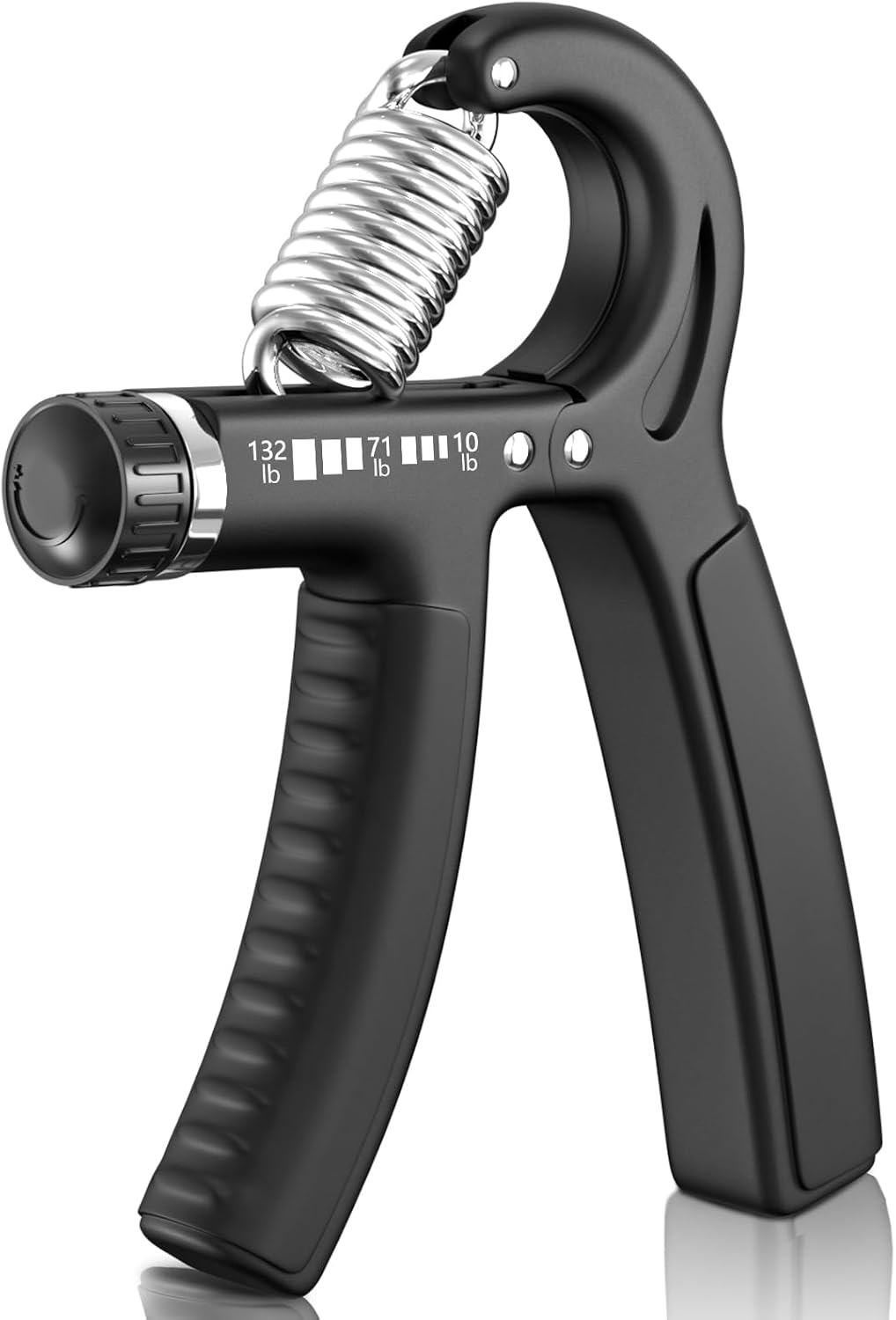
FitBeast lists six exercises covering hand, finger and forearm work, and customer support is available if you want guidance on them. I stuck mostly to standard squeeze-and-release reps at various settings in my testing.
Clicking takes you to the seller's website. We may earn a small commission if you purchase, at no extra cost to you.
If you want one grip trainer that starts light enough for rehab and still has somewhere to grow when you get strong, get this one at the link below.
Learn more
FitBeast Adjustable Hand Grip Strengthener
Get the best price today →This post contains affiliate links. I may earn a commission at no extra cost to you.
🛍️ Shop everything in this video
Every product mentioned, in one place — these are affiliate links, so I may earn a small commission at no extra cost to you.
🛍️ Fitbeast Adjustable Hand Grip Strengthener — check price on Amazon →
About the reviewer
Seb and Michelle
We've tested over 6,500 products in the last 5 years - collaborating with over 4,000 brands and bringing our style of reviews to multiple platforms.