Swamp Cooler for Large Spaces: 3880 CFM Tested
We tested this swamp cooler on 1000 sq ft coverage claims. Here's what the specs don't tell you about garages, patios, and humid climates.

Reviewed by
Seb and Michelle
We've tested over 6,500 products in the last 5 years – collaborating with over 4,000 brands and bringing our style of reviews to multiple platforms. More about me →
This post contains affiliate links. I may earn a commission at no extra cost to you.
Quick Verdict
This swamp cooler delivers serious airflow for the price — 3880 CFM across 1000 square feet is no joke for a portable unit with wheels and a remote. But “cooler” is doing real work in that sentence, and if you’re in a humid climate, you need to understand what you’re buying before it shows up at your door. In dry heat — a garage, a warehouse, a shaded patio — this thing earns its price tag. In muggy, coastal air, it’s more of a strong fan with a water tank.
Buy if you:
- Need to cool a garage, workshop, or warehouse without installing a mini-split
- Live in a dry or semi-arid climate where evaporative cooling works as intended
- Want to slash summer energy costs compared to running a traditional AC unit
- Need a portable unit that moves between spaces — the wheels actually matter here
Skip if you:
- Live in a high-humidity environment — evaporative cooling loses effectiveness fast
- Expect the same drop in temperature as a refrigerant-based air conditioner
- Want something for a sealed, insulated bedroom or living room
We Live in the Caribbean. We Know Hot.
St. Martin is not a place that lets you be casual about heat management. We’re talking 90°F days with humidity that makes your shirt feel like a second skin by 9 a.m. So when a swamp cooler promising to handle 1000 square feet landed in our hands, we weren’t reviewing it from a comfortable air-conditioned office. We were reviewing it from the island where cooling isn’t a luxury — it’s a necessity. And we didn’t just set it up in a climate-controlled showroom. We ran it in real conditions, in real spaces, and pushed it to find where the limits are. You can grab it on Amazon here: check today’s price and availability. But before you do — read this first, because there’s something important the product listing won’t explain clearly enough.
The title of our video says “don’t buy until you watch this.” That’s not clickbait. It’s a genuine warning. Not because this product is bad — it’s not — but because swamp coolers come with a condition that changes the entire equation depending on where you live. And most Amazon listings bury that detail in the fine print if they mention it at all.
So let’s break it all down: what it is, what it does, what it doesn’t do, and who it’s actually built for.
3880 CFM Is a Lot of Air. Here’s What That Means.
CFM stands for cubic feet per minute. It’s the measurement of how much air a fan or cooler pushes through a space in sixty seconds. Most standard box fans you’d buy at a hardware store top out somewhere around 1000–1500 CFM. Window AC units typically move even less air by volume because they’re pushing cooled, conditioned air rather than raw volume.
This unit moves 3880 CFM. That’s not a subtle number. For context, that’s enough airflow to completely cycle the air in a 1000-square-foot open space roughly every few minutes. The 37 feet per second wind speed claim is the other piece of this — that’s the velocity at which the air exits the unit, which determines how far across a garage, warehouse, or patio floor the cooling effect actually reaches.
The coverage rating of 1000 square feet is plausible for an open, unobstructed space. A single-car garage is typically 200–250 square feet. A two-car garage runs 400–500. A large workshop or small warehouse floor at 800–1000 square feet? This is where this unit starts to make real sense, especially if you’ve been running window AC units or portable compressor-based ACs and watching your electricity bill climb every month.
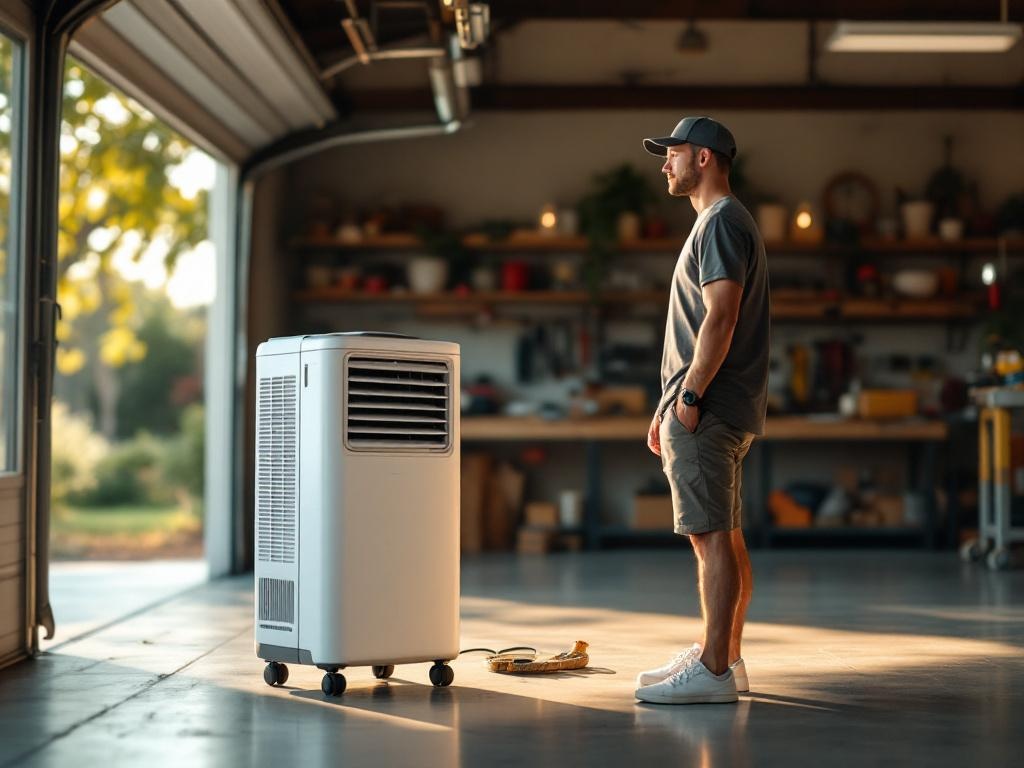
The wheels are worth calling out specifically. Not because they’re a surprise feature, but because they genuinely change how you use the unit. You can roll it from the garage to the patio, back inside to the workshop, stage it near the open bay door in the morning, reposition it in the afternoon when the sun shifts. That flexibility is what separates a swamp cooler with wheels from one you bolt to a wall and forget about.
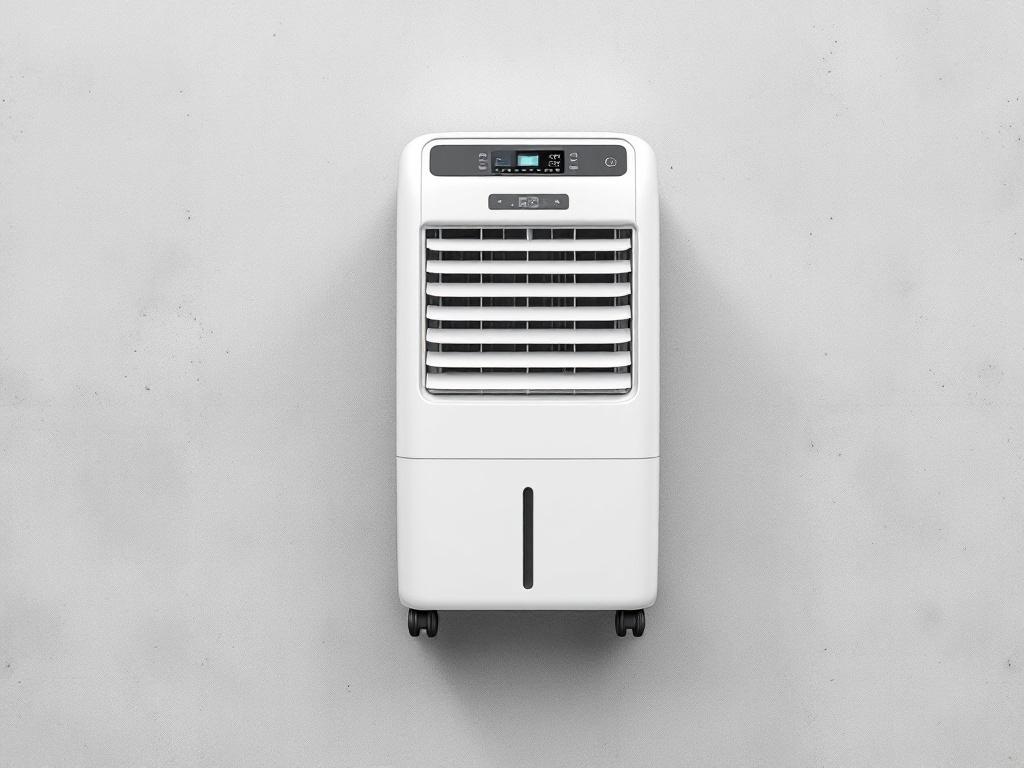
The remote control is a similar story. You’re sweaty, your hands are dirty, you’re mid-project — the last thing you want to do is walk across the shop to change the fan speed. The remote handles it. Small thing on paper, genuinely useful in practice.
And the digital display panel gives you control over fan speed settings, water pump operation, and oscillation. Multi-speed fans on evaporative coolers matter more than on regular fans because the slower speeds let you manage evaporation rate, which in turn affects how efficiently the unit uses water. On high, it moves air fast. On low, it runs quieter and stretches the tank refill interval.
The Garage Test Told Us What We Needed to Know
Put a swamp cooler in a closed bedroom with a window AC unit and you’ll be disappointed. Put it in an open garage on a 95°F afternoon with the door rolled up and a light breeze coming in — and that’s a completely different story.
Evaporative coolers need two things to do their job: dry-ish air and airflow. The physics are simple. Water evaporates, evaporation absorbs heat, the air moving through the wet pads comes out cooler. But if the air already has a high moisture content — high relative humidity — the evaporation slows dramatically. There’s only so much moisture the air can absorb, and when it’s already near capacity, the cooling effect drops off hard.
In spaces with ventilation — an open garage door, a patio, a warehouse with roll-up doors — the air moves through and exchanges continuously. Fresh, slightly drier air keeps coming in. The cooler keeps evaporating. The process keeps working. That’s the sweet spot for this unit.
We ran this unit in a large open space in the midday heat. The airflow is immediately noticeable — 3880 CFM is a lot of air moving, and you feel it. The drop in perceived temperature when you’re standing in the direct airstream is meaningful. We’re not talking a couple of degrees — it’s the difference between standing in front of a window fan and standing in front of something that’s delivering actual relief.
Noise is reasonable for a unit this size. High speed is audible — you know it’s running. But it’s not the kind of thing that makes conversation impossible or that you’d find irritating across a large workshop. Think industrial fan hum, not jet engine. The motor noise is consistent and doesn’t have any of the rattling, whining, or vibration that you’d expect from a budget-tier unit trying to push this much air.
Water consumption is the other real-world factor. You will be refilling this thing, especially on hot days running on high speed. How often depends on tank capacity and ambient conditions, but plan for it. This isn’t a set-it-and-forget-it appliance for a full workday without checking the water level.
Setup out of the box is straightforward. Attach the panels, fill the water tank, plug it in. No installation. No technician. No refrigerant to worry about. That’s the other part of the value proposition that doesn’t get talked about enough — the barrier to using this thing is almost zero.
The Humidity Trap Nobody Explains Clearly
Here’s what most swamp cooler listings don’t say clearly enough: evaporative cooling is a technology that works in direct proportion to how dry your air is. The manufacturer isn’t lying about the 1000 square foot rating. But that rating assumes conditions where the evaporation process can actually run efficiently. That means relative humidity below roughly 60%, and ideally below 50%.
In the American Southwest — Arizona, Nevada, inland California, New Mexico — this unit is going to be a beast. Those climates are bone dry in summer. Evaporative coolers are the default cooling solution for a reason. In those conditions, a unit with 3880 CFM can legitimately transform a large space.
In Florida. In coastal Texas. In the Gulf states. In tropical climates like ours here on St. Martin? The math changes. When humidity is sitting at 70%, 80%, or higher, the cooler becomes more of a high-powered fan with occasional misting effect. That’s not nothing — airflow still matters, moving air always feels cooler than still air — but you’re not going to feel the same dramatic drop in temperature that someone in Phoenix would experience with the same unit.
This isn’t a flaw. It’s just physics. And it’s information buyers in humid climates deserve to have upfront rather than discovering it after the return window closes.
The energy efficiency angle is real regardless of climate. This unit consumes a fraction of the electricity that a refrigerant-based portable AC or mini-split pulls. If you’re in a humid region but your main goal is moving a large volume of air around a garage or patio while keeping the power bill in check, the swamp cooler still wins on cost per hour of operation. Just go in with accurate expectations.
Get it now
Large Space Swamp Cooler
🛒 See Today’s Price on Amazon →This post contains affiliate links. I may earn a commission at no extra cost to you.

The Garage, the Patio, the Workshop — Pick Your Fight
Let’s talk about the spaces where this unit genuinely shines, because they’re specific enough that it matters whether your situation actually matches.
The two-car garage is probably the most common use case for a unit this size. A 400–500 square foot garage with a door open gets a steady exchange of outside air. You’re not trying to cool a sealed, insulated room — you’re trying to make a workspace tolerable in the middle of summer. For someone working on a car, building furniture, doing home renovation projects, or just trying to avoid heat exhaustion while doing weekend work — this unit covers that space with room to spare.
Covered patios are another strong match. The patio is open to the outside by nature, which is exactly the airflow environment evaporative coolers need. You get the cooling benefit right in the zone where you’re sitting, dining, or entertaining. A 37-foot-per-second wind speed delivers air well past a dining table without becoming uncomfortable. And because the patio is shaded, the ambient temperature is already lower than full sun exposure, which gives the evaporation process a better starting point.
Warehouses and workshops are the commercial use case, and the portability story matters most here. A small business owner who needs to cool a receiving area in the morning and a workspace in the afternoon can roll this unit wherever it’s needed rather than investing in permanent HVAC infrastructure that costs thousands. For a unit priced the way this one is, the return on investment calculation is pretty fast if your alternative was a window AC unit installation or a mini-split.
Large open retail spaces, outdoor markets, tent events — we’ve seen swamp coolers deployed in all of these. The 3880 CFM moves enough air to cover a meaningful area when pointed strategically. Pair two of these units at either end of a long space and you’ve got cross-ventilation that changes the entire environment without a generator-sized electricity bill.
The one scenario where this unit doesn’t belong is the closed bedroom. If you’re shopping for bedroom cooling, this is not the product. Sealed rooms trap the humidity that evaporative coolers generate as a byproduct. You’ll end up warmer and stickier than when you started. That’s a different category of product entirely.
Swamp Cooler vs. Portable AC: The Trade-Off Table
People shopping in this category are almost always deciding between a swamp cooler and a portable air conditioner. They look similar from the outside — both are large units on wheels, both plug into a standard outlet, both are marketed as “portable cooling.” But they work completely differently, and the decision comes down to three factors: climate, space type, and budget.
A portable refrigerant AC unit cools air through a compressor cycle. It pulls warm air in, runs it over cold coils, and pushes cooled air out — the same process as your home central air or a window unit. It works in any humidity level. It works in sealed spaces. The temperature drop is consistent and predictable. But it uses a lot of electricity, typically 1000–1500 watts or more for a unit sized to cover 1000 square feet. And it exhausts hot air that has to go somewhere, usually via a window hose kit that limits where you can use it.
The swamp cooler uses maybe 150–300 watts for the same footprint of coverage in the right conditions. No exhaust hose. No refrigerant. No compressor noise. It works anywhere you have power and a water source. But it depends on ambient humidity. In dry conditions it outperforms a portable AC on energy efficiency by a wide margin. In humid conditions it can’t match the cooling depth a compressor-based unit provides.
So the decision tree looks like this: if you’re in a dry climate and cooling an open or ventilated space, the swamp cooler wins on every metric except raw temperature drop. If you’re in a humid climate or cooling a sealed room, spend the extra money on a portable AC. If you’re on a tight budget and just need to make a large open space survivable in summer, the swamp cooler gives you the most cooling per dollar in operating costs.
There’s also a durability angle. Portable ACs have compressors that can fail, refrigerant systems that can leak, and moving parts under significant mechanical stress. A swamp cooler’s mechanics are simpler — a motor, a pump, and cooling pads. Fewer failure points. Easier to service. The pads need replacement periodically, and that’s a low-cost consumable. If you run a workshop and need something that’s going to take abuse across multiple summers, the simpler mechanical profile of an evaporative cooler has real long-term advantages.
Before You Pull the Trigger
A few things we’d want someone to know going in, because they’d have changed how we set up our initial test.
Check your humidity before you buy. Pull up your local weather app and look at what relative humidity runs in your area during summer. Below 60%? You’re in swamp cooler territory. Above 70%? You’re going to be underwhelmed if your expectation is significant temperature reduction. This one data point will save you a lot of second-guessing.
Position matters more than you’d think. A swamp cooler pointed directly at where you’re working — not at a wall, not at a ceiling — changes the experience. The 37 feet per second wind speed delivers real comfort when it’s aimed at you. When it’s pointed at a wall across the room, you’re just moving air around without the direct benefit. Treat it like a directional tool, not a whole-room solution.
Plan for water. Not as a complaint — just as logistics. If you’re running this unit eight hours a day in a hot garage, you’ll be refilling the tank. Build that into your routine. Some people set up a small water line connection if the unit supports it. Worth exploring if you’re using it in a fixed location daily.
The cooling pads need maintenance. Over time, mineral deposits from water will build up on the pads and reduce evaporation efficiency. Most manufacturers recommend rinsing or replacing pads seasonally. It’s not a difficult task, but it’s one that occasional owners skip and then wonder why the unit isn’t cooling as well in year two as it did in year one.
And one more thing: if you’re buying this for a space that gets direct sun all day, the ambient temperature loading on the unit is going to be higher than the specs assume. This cooler was rated for a large space, but a fully sun-exposed, un-shaded metal building at 110°F inside is going to push it. If that’s your situation, either shade the building first or consider a supplemental cooling source. The swamp cooler works best when it’s not fighting a heat load that’s overwhelming the evaporation capacity.
Bottom line: buy it with your eyes open, set it up in the right environment, and it delivers. See the current price on Amazon here and check that it’s in stock — availability on these larger units can fluctuate heading into peak summer demand.
Frequently Asked Questions
Does this swamp cooler work in humid climates?
Not as well as it does in dry climates. Evaporative cooling depends on moisture evaporating into the air, and if your air is already saturated with humidity, that process slows way down. You’ll still get strong airflow, but the temperature drop will be minimal compared to what someone in a dry region would experience.
Can it cool a 1000 square foot space to the same level as a central air system?
No. The 1000 square foot rating refers to coverage area for airflow distribution, not the ability to bring a large space down to 72°F the way central AC would. In the right conditions, it makes a large space comfortably cooler. It won’t match the controlled temperature of a refrigerant system.
How often do you need to refill the water tank?
Depends on the temperature and fan speed setting. On a hot day running high, expect to refill more frequently — potentially every few hours for continuous use. On lower speeds in milder conditions, you’ll get significantly longer runtime between refills. Check the tank capacity specs on the Amazon listing for the specific volume.
Is this unit loud enough to be disruptive in a workspace?
On high speed, it’s audible — definitely louder than a quiet household fan. But in a garage or workshop setting where there’s already tool noise, it blends in. Conversation is still possible. It’s not the kind of noise that’s going to drive you out of the room, and lower speed settings bring it down noticeably.
How does the energy cost compare to running a portable air conditioner?
Significantly lower. Evaporative coolers run motors and a small pump rather than a compressor. A comparable portable AC unit drawing 1200–1500 watts costs roughly 5–10x more per hour to operate than a swamp cooler pulling 150–300 watts. For daily use over a summer, that difference adds up fast on your electricity bill.
Related reviews
- Creatine Gummies vs Powder: Which One Works Better?
- Sigenergy SigenStor Off-Grid Caribbean: Worth It?
- Tarte Lip Plumper Gloss: Hydration & Fuller Lips
Can you use this on a covered patio or outdoor event space?
Yes, and this is one of the best use cases for it. Open-air spaces with natural airflow are exactly the environment evaporative cooling thrives in. The wheels make repositioning easy, and the remote means you’re not constantly walking to it to adjust settings. Just keep it protected from direct rain.
Get it now
Large Space Swamp Cooler
🛒 See Today’s Price on Amazon →This post contains affiliate links. I may earn a commission at no extra cost to you.
About the reviewer
Seb and Michelle
We've tested over 6,500 products in the last 5 years - collaborating with over 4,000 brands and bringing our style of reviews to multiple platforms.