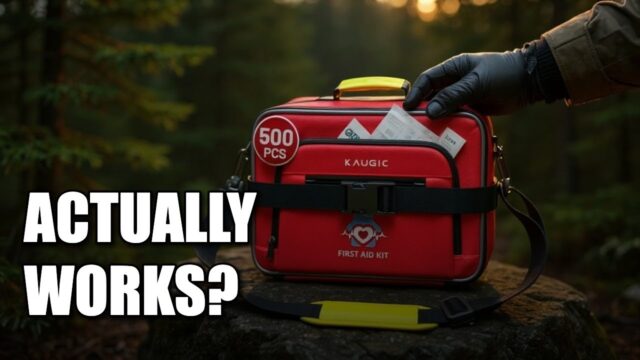
KAUGIC First Aid Kit: Worth the Investment? Review
A hands-on look at the KAUGIC 500-piece first aid kit: flat-lay organization, restockable sets, and whether this travel aid kit earns a spot in your car.
This post contains affiliate links. I may earn a commission at no extra cost to you.
Quick Verdict
The moment this aid kit opened flat on the table like a spread-out tray, I got it. 500 pieces, sorted into labeled compartments, and it snaps back shut the same way it opened. This is the kind of kit you strap to a truck, a bike, or leave in the car and forget about until you need it.
Buy if you:
- Want a grab-and-go kit for the car, truck, bike, or motorcycle
- Camp or hike and want everything visible at a glance
- Hate scrambling through scattered supplies in an emergency
- Want spares of the consumables so you don’t run out after one use
Skip if you:
- Expect the top compartment to arrive pre-loaded, it’s empty for your own storage
- Want a slim pocket kit, this is a full organized bag with a shoulder strap
- Already own a well-stocked kit and don’t need multiples around the house
Clicking takes you to the seller's website. We may earn a small commission if you purchase, at no extra cost to you.
The Aid Kit Design That Sold Me
KAUGIC sent me this kit, and I understood what made it different in about four seconds: unzip the main compartment, flip the flap, and the entire kit spreads flat on a table like a field tray, gauze in one labeled pouch, wound care in another, emergency tools in a third. Every item visible, nothing buried. No unloading the bag onto the seat of your car trying to find a bandage. If you want to check the current price, you can see it here on Amazon.
That flat-lay layout is genius for emergencies, when stress makes it hard to hunt through a disorganized bag. In an emergency you don’t have time to hunt. You flip the flap open, everything’s laid out and visible, and you go. That alone separates this aid kit from the bulky, unreliable ones that just dump supplies into one pocket.
What’s Packed Into 500 Pieces
This is 500 pieces, I repeat, 500 pieces. And it’s not padded with filler. You get cooling patches, a first aid guide, tape (both skin tape that doesn’t tear your skin up and a gauze-style tape), a ton of bandages, ice packs, gloves, triangular bandages for a shoulder brace, larger gauze pads, cotton balls, a floss pick, lancets, and cotton swabs. There’s even a little pill container, which was the first time I’d seen that included in a kit like this.
The bag itself is made from 1680D tear-resistant polyester, so it’s built for rugged conditions and it’s water splash resistant. On the back you’ve got straps to secure it to a truck, car, bicycle, or motorcycle, plus a MOLLE system for attaching to backpacks or gear. Two yellow handles, one on each side, let you carry it however you want.
| Spec | Detail |
|---|---|
| Piece count | 500 pcs medical + survival supplies |
| Material | 1680D tear-resistant polyester |
| Water resistance | Splash resistant |
| Carry options | Adjustable shoulder strap, MOLLE system, 2 side handles |
| Layout | Labeled flat-lay compartments (Gauze & Bandage, Wound Care, Emergency Tools) |
| Includes | First aid guide, CPR shield, compass, emergency blanket, survival whistle |
Opening It Up On The Table
The first thing I did was unzip it and check that top compartment. Empty. But that’s not a miss, that’s extra storage for whatever you want to add yourself. The main compartment is where all the stuff lives, and when I flipped the flap open, the layout sold me. Everything sits in its own labeled pouch, and it’s all visible, which is very, very important to me.
What stood out most: they don’t throw just one of each consumable in there. You get sets. So when you use a cooling patch once, you’re not left going, oh man, I need to replenish this right away. You’ve already got backups sitting there. That’s a really cool thing that saves you a trip to the store after the first use.
The Repack Is Where Most Kits Fail
Here’s the real test with any organized bag: can you put it back the way it was? So often you’ll see kits that look great out of the box and then you’re never able to repack them, and they end up a jammed mess. Not this one. After going through everything, I folded the sections in, brought the flap over, snapped it into place, and closed it up. Easy. Ready to go back in the car for the next time.
Most organized kits I’ve seen lose their shape after the first real use, pouches get jammed, zippers fight you. This one folded back in the same order it came out, snapped shut, and looked like I hadn’t touched it.
The One Thing To Know Going In
That top compartment being empty threw me for a second. I opened it expecting supplies and found nothing, then realized it’s meant to be your own bonus storage. It’s not a flaw once you understand it, but if you’re expecting all 500 pieces spread across every pocket, know that the top pouch is yours to fill. Add your own meds, an EpiPen, personal prescriptions, whatever your family actually needs.
And do yourself a favor: read the included first aid guide before you ever need it. It’s very, very important to get acquainted with the tools now, not in the middle of an emergency. Knowing where the CPR shield and triangular bandages are ahead of time is the whole point.
Get it now
KAUGIC 500-Piece First Aid Kit
Get the best price on Amazon →This post contains affiliate links. I may earn a commission at no extra cost to you.

Who This Aid Kit Is For
Anyone who spends time away from a medicine cabinet. The straps and MOLLE system mean it lives happily on the side of a truck, a car door pocket, a bike, or a motorcycle, so it’s always at the ready. Campers and hikers get the flat-lay visibility. Families get the labeled compartments so anyone can grab the right thing fast, not just the person who packed it.
My take from handling it: this is the kind of thing you buy more than one of. One in the house, one in the car, one at the camping site. Because when you need a first aid kit, you need it where you are, not in the other room.
Advice Before You Buy
Customize the empty top pouch right away. Add your family’s specific needs before you stash it in the car, because a generic kit plus your personal meds is what makes it truly ready. Restock the consumables as you use them, since the extra sets buy you time but they aren’t infinite. And keep it somewhere you can grab it one-handed, that shoulder strap exists for a reason.
One more: practice opening and repacking it once at home. The flat-lay is easy, but muscle memory beats fumbling. A couple minutes of practice now means it works the way it’s meant to when it counts.
Pros
- Flat-lay main compartment shows everything at a glance so you can grab items at the ready
- Comes with sets of consumables, not just one of each, so you don’t run out after a single use
- Repacks easily and snaps back exactly the way it opened
- Straps, MOLLE system, and two side handles make it truly grab-and-go
- 500 pieces covering wound care, tools, tape, gloves, and even a pill container
Cons
- Top compartment arrives empty, which surprised me at first before I realized it’s for your own storage
- It’s a full organized bag with a shoulder strap, not a slim pocket kit
- You’ll want to add personal meds yourself since it covers general supplies
Frequently Asked Questions
Does the aid kit come with everything, or is a compartment empty?
The main compartment is fully loaded with all 500 pieces, but the top pouch arrives empty on purpose. It’s extra storage so you can add your own meds, prescriptions, or personal items. Don’t mistake it for a missing section.
Can I mount this first aid kit to my car or bike?
Yes. It has straps on the back plus a MOLLE system, so you can attach it to a truck, car, bicycle, motorcycle, or backpack. That’s what makes it a true on-the-go kit rather than something stuck in a drawer.
Is the bag durable enough for outdoor and camping use?
It’s made from 1680D tear-resistant polyester and is splash resistant, so it’s built for rugged conditions. The high-density fabric resists punctures and abrasions, which is exactly what you want strapped to gear outdoors.
How hard is it to repack after opening?
Easy, which is rare. Fold the sections in, bring the flap over, snap it into place, and zip it shut. Unlike a lot of organized bags, everything goes back exactly where it started.
Should I buy more than one?
Having multiples makes sense if you split time between home, car, and outdoors. A first aid kit only helps if it’s where the emergency happens, so one in the house, one in the vehicle, and one at your camp or gear bag covers your bases.
Does it include a first aid guide for beginners?
Yes, there’s a first aid guide inside, and reading it early is worth it. It walks you through getting acquainted with the tools and supplies so you’re not learning on the fly during an actual emergency.
Can I restock the supplies when they run low?
Yes, and it’s designed for it. The consumables come in sets so you have spares built in, and there’s ample space to restock or customize with your own supplies over time.
Is this good as a gift for family or outdoor folks?
The labeled flat-lay is what makes it giftable: whoever opens it, a new driver, a camping-obsessed sibling, a parent who keeps nothing but expired Band-Aids in the glove box, can find the right pouch without reading a manual. That’s the bar a gift kit needs to clear, and this one does.
Get it now
KAUGIC 500-Piece First Aid Kit
Get the best price on Amazon →This post contains affiliate links. I may earn a commission at no extra cost to you.
🛍️ Shop everything in this video
Every product mentioned, in one place — these are affiliate links, so I may earn a small commission at no extra cost to you.
🛍️ Kajik 500 Piece Travel First Aid Kit — check price on Amazon →